 |
An innovative plant growth promoter for organic and traditional farming
|
 
|
Alfalfa |
|


Materials of this chapter were published in the book 'Biological product Albit for yield increase and plant protection: trials, recommendations, results of application' edited by member of the Academy V.G. Mineev. All-Russian Scientific Research Institute of Plant Protection, Ministry of Agriculture of the Russian Federation, 2009, and also in articles:
- Harchenko G.L. Methods for increasing the alfalfa productivity / G.L. Harchenko, Т.А. Ryabchinskaya, N.А. Sarantseva, I.Yu. Bobreshova, А.К. Zlotnikov, V.K. Gins // Zashchita i Karantin Rastenii (Plant Protection and Quarantine). – № 5. – 2008. – P. 36-37.
- Harchenko G.L. Assessment of influence of growth regulator Albit on yield of fodder grasses / G.L. Harchenko, Т.А. Ryabchinskaya, N.А. Sarantseva, I.Yu. Bobreshova // Vestnik RASHN (Herald of the RAAS). – № 6. – 2009. – С. 31–33. (in Russian)
 Alfalfa
has a leading position among perennial forage grasses, because alfalfa may
be harvested for several times during the season, and also, it has a high yield
and nutritional value. One of the effective methods for increasing the productivity
of alfalfa is introduction of multifunctional products into the technology
of plant cultivation.
Alfalfa
has a leading position among perennial forage grasses, because alfalfa may
be harvested for several times during the season, and also, it has a high yield
and nutritional value. One of the effective methods for increasing the productivity
of alfalfa is introduction of multifunctional products into the technology
of plant cultivation.
Currently, the number of plant protectants of alfalfa is extremely limited. Only 3 growth regulators and 1 fungicide are registered on alfalfa ('The State Catalogue of Pesticides and Agrochemicals Permitted for Application in the Russian Federation', 2018).
Albit is one of few product registered in Russia. It has a high efficacy as a plant growth regulator of alfalfa. Albit increases the field germination, accelerates regrowth after mowing, increases the number of inflorescences, activates growth and development, increases the plant resistance to unfavorable conditions of environment, provides the defense against plant diseases, increases the green mass yield, improves the product quality. On alfalfa, Albit is also applied as antidote for decreasing the side phytotoxic effect of pesticides.
Application recommendations. It is recommended presowing seed treatment (50 mL/t) and foliar spraying: first – at the beginning of vegetation after overwintering (40 mL/ha); the second – 2-3 fold spraying during 7 days after each mowing (70 mL/hа). Foliar spraying also may be applied for regrowth of plants after severe pest damage. It is more efficient to apply Albit in tank mix with leaf fertilizers and also in tank mix with insecticides.
Albit had been tested on alfalfa since 2001 in field trials in Moscow, Voronezh regions, Stavropol krai, EU countries and other regions. Field trials were conducted by All-Russian Research Institute of Vegetable Breeding and Seed Production (VNIISSOK), All-Russian Research Institute of Plant Protection (VNIIZR), collective farm Rus (station Georgievskaya of Stavropol region), and also in other farms and scientific institutions on varieties Severnaya gibridnaya, Pavlovskaya pestraya and others.
Field trial was conducted in All-Russia Institute of Vegetable Selection and Seed Breeding of Moscow region in 2001. Evaluation of the effectiveness of Albit was conducted on alfalfa var. Severnaya gibridnaya of the first cultivation year. Pre-sowing seed treatment and spraying of plants at the budding stage were carried out with the following Albit dosages: 25 mL/t + 20 mL/ha, 50 mL/t + 40 mL/ha and 100 mL/t + 80 mL/ha. Pre-sowing seed treatment of alfalfa with Albit increased the field germination by 5-10%, plant height by 5-10% and density of plants. In the control, the yield of green mass was 7.6 t/ha. In the variant with Albit (25 mL/t + 20 mL/ha), a reliable yield increase was 10.5%. In variant with Albit (50 mL/t + 40 mL/ha), the highest yield increase of the green mass was obtained – 19.7%. In variant with Albit (100 mL/t + 80 mL/ha), yield increase to control was 15.1%. Thus, based on this trial, variant with Albit 40 mL/ha is optimal for increasing the plant biomass.
It is known that yield of alfalfa significantly declines on the third year, density of plants also decreases by more than 40%. In 2007, influence of Albit on middle-aged plants of alfalfa var. Pavlovskaya pestraya of 4th year cultivation was conducted in Voronezh region. In spring, plants were sprayed with Albit in the beginning of the growing season and then – 7-10 days after each mowing. Albit was applied in 3 variants: 40, 70 and 100 mL/ha. 40 days after spraying, the number of stems per 1 plant was by 13.5-17.7% higher over untreated plot. The best results were obtained in variant with Albit in dosages 40 and 70 mL/ha (29.5-30.6 shoots per plant). By the time of mowing, the number of productive stems of alfalfa increased up to 15.6-29.1%. Assessment of biometric parameters and vegetative mass of alfalfa were carried out before each mowing. In this trial, Albit showed better results than in control. Spraying of new shoots promoted of increased total productivity of plants due to formation of a larger number of lateral fruit-bearing shoots than in control. Spraying of plants with Albit during regrowth of shoots after first and second mowings significantly increased the number of stems by 30-78.5%.
Unfavorable weather conditions of 2007 negatively affected on development and productivity of alfalfa. The early warm spring was replaced by cooling (by 1.6-2.6°C below of average spring temperatures in II-III decades of April and in the first decade of May) with a lack of moisture during of all growing season. This did not allow to obtain a high yield of green mass of alfalfa. However, Albit application contributed to rapid regrowth of perennial grasses. The first mowing was carried out in the earlier periods. Generally, the number of side shoots of productive stems was significantly higher than in control. For example, in variant with Albit 70 mL/ha, this parameter was 2205-2614 pcs./m2: in 1.7-2.2 times higher than on untreated area.
Spraying of alfalfa with Albit promoted to increasing the yield of green mass. As a result of Albit application at the beginning of the renewal of growing season of crop, yield of green biomass was 12.72-14.25 t/ha (yield increase – 13.3-26.9% to control). The optimal application rate of Albit – 40 mL/ha. The yield increase of the second and third mowing reached 57.4-92.0% in variant with Albit – 70 mL/ha (Fig. 1, Table 1).
Also, Albit allowed to significantly increase the number of inflorescences on one productive stem from 1.1 and 2.0 in control to 1.7 and 2.8 pcs./plant in the 2nd and the 3rd mowing, respectively. This parameter was 975 and 1438 inflorescences per 1 m2 in the variant with Albit 70 mL/ha: in 2.2-2.9 times higher than in control and by 18-54% higher compared to other dosages of Albit (40 and 100 mL/ha).
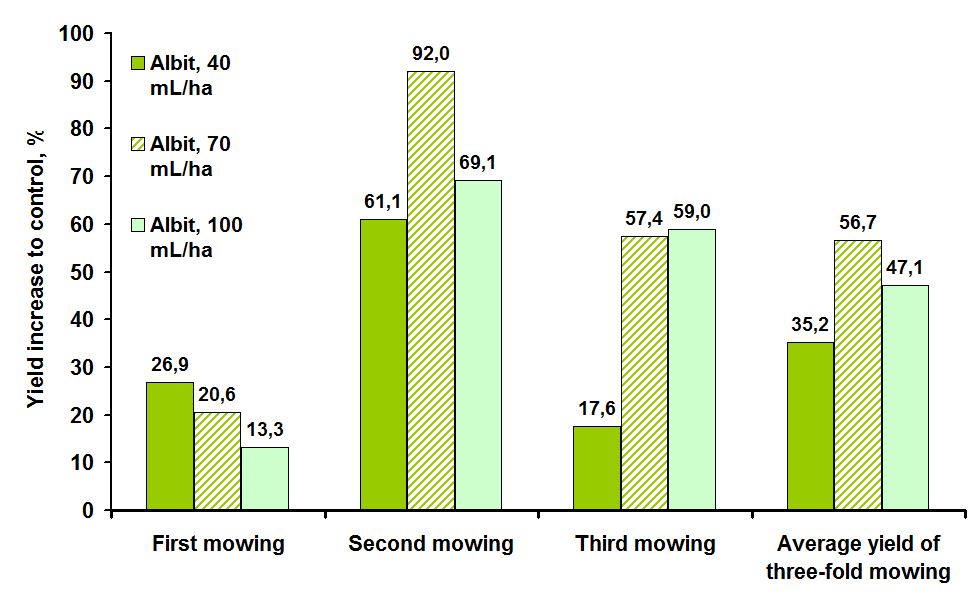
Fig. 1. Influence of various dosages of Albit on yield of green mass of alfalfa var. Pavlovskaya pestraya (All-Russia Institute of Plant Protection, Voronezh oblast, 2007)
Fungistatic effect of Albit against complex of leaf alfalfa diseases was also evaluated in this field trial. Biological efficiency of Albit against brown spot and Ascochyta leaf spot was 16–73% with a low and medium level of disease development.
Thus, some parameters of the vegetative growth of alfalfa were studied in variants with Albit application. In this trial bushiness, plant height, speed of shoot formation increased; onset of budding phase accelerated, the number of inflorescences and total plant biomass increased, plants had higher resistance to many diseases (Table 1).
Table 1. Growth-stimulating effect of Albit treatment on alfalfa (All-Russian Research Institute of Plant Protection, 2007)
| Account | Variant | Productive stems | Height of stems, cm | Amount of inflorescences, pcs/m2 | Yield of green mass, t/ha | Yield increase | ||
| pcs/m2 | % | t/ha | % | |||||
| First mowing (May) | Control |
343 | 100 | 37,4 | – | 11,23 | – | – |
Albit, 40 mL/ha |
443 | 129,1 | 36,4 | – | 14,25 | 3,02 | 26,9 | |
Albit, 70 mL/ha |
397 | 115,6 | 39,0 | – | 13,54 | 2,31 | 20,6 | |
Albit, 100 mL/ha |
399 | 116,3 | 36,9 | – | 12,72 | 1,49 | 13,3 | |
| Second mowing (July) | Control |
321 | 100 | 24,3 | 337 | 4,76 | – | – |
Albit, 40 mL/ha |
546 | 170,1 | 24,9 | 633 | 7,67 | 2,91 | 61,1 | |
Albit, 70 mL/ha |
573 | 178,5 | 28,1 | 975 | 9,14 | 4,38 | 92,0 | |
Albit, 100 mL/ha |
430 | 134,0 | 29,3 | 735 | 8,05 | 3,29 | 69,1 | |
| Third mowing (August) | Control |
332 | 100 | 27,7 | 652 | 6,19 | – | – |
Albit, 40 mL/ha |
407 | 122,6 | 30,7 | 965 | 7,28 | 1,09 | 17,6 | |
Albit, 70 mL/ha |
505 | 152,1 | 32,3 | 1438 | 9,74 | 3,55 | 57,4 | |
Albit, 100 mL/ha |
537 | 161,7 | 32,5 | 1233 | 9,84 | 3,65 | 59,0 | |
Application of Albit on alfalfa was economically highly profitable. The total net income of three fold mowing in variants with 40, 70 and 100 mL/ha of Albit was 6900, 10678, and 8014 rubles/ha, respectively, payback was 4.9–6.1 times (Table 2).
Table 2. Economic efficiency of Albit application on alfalfa (All-Russian Research Institute of Plant Protection, 2007)
| Variant | Yield increase, t/ha | Pure income, rubles/ha | Profitability, % | Payback |
|
Albit, 40 mL/ha |
First mowing |
3,02 | 3020 | 521 | 6,2 |
Second mowing |
2,91 | 2912 | 513 | 6,1 | |
Third mowing |
1,09 | 968 | 275 | 3,8 | |
Total, average |
7,02 | 6900 | 460 | 5,6 | |
Albit, 70 mL/ha |
First mowing |
2,31 | 2198 | 391 | 4,9 |
Second mowing |
4,38 | 4986 | 613 | 7,1 | |
Third mowing |
3,55 | 3494 | 495 | 5,9 | |
Total, average |
10,24 | 10678 | 513 | 6,1 | |
Albit, 100 mL/ha |
First mowing |
1,49 | 1268 | 238 | 3,4 |
Second mowing |
3,29 | 3212 | 429 | 5,3 | |
Third mowing |
3,65 | 3536 | 451 | 5,5 | |
Total, average |
8,33 | 8014 | 388 | 4,9 | |
Application of Albit is also effective method against pests. For example, in 2014, alfalfa suffered from Heliothis viriplaca in the farm Polar Star of Stavropol krai. Leaves were severe damaged. Then fields were treated with Albit in doses 100 mL/ha. Almost immediately after treatment, the plants began to grow, foliage quickly grew and crop was successfully preserved at the level of last year, when the development of insect pests was not observed.
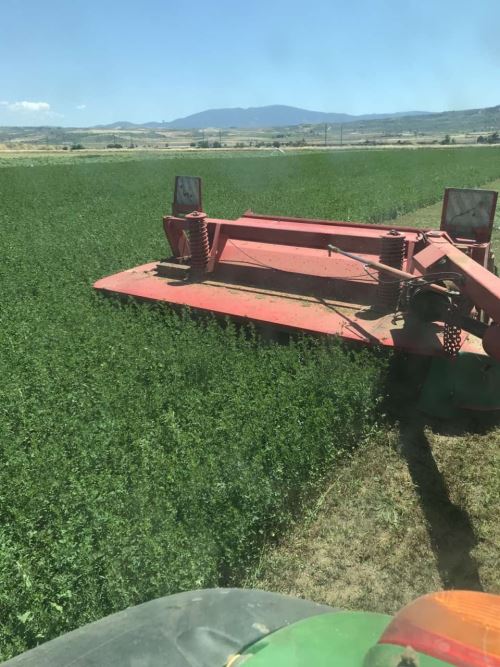
In 2022 Albit was applied on alfalfa in Greece. Albit increased yield of green mass by 50-55% vs. control (Fig. 2).
 |
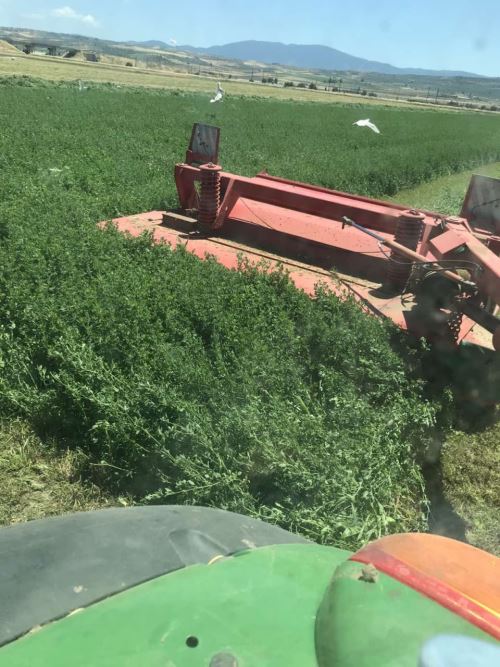 |
Fig. 2. Effect of Albit on yield of green mass of alfalfa. Left – control, right – treatment with Albit (one-fold application) (Thiva, Boeotia, Greece, 2022)
In the following Table, you may see reports on performance of Albit on alfalfa. For all available reports, please see corresponding table on Russian webpage.
№ |
Year |
Country |
Region |
Institute / Farm |
Report |
1. |
2001 |
Russia |
Moscow region |
All-Russia Institute of Vegetable Selection and Seed Breeding |
 |
| NOTICE: | Information contained on this page is provided according
to the Terms and Conditions located at
www.albit.com/application/disclaimer.php
|